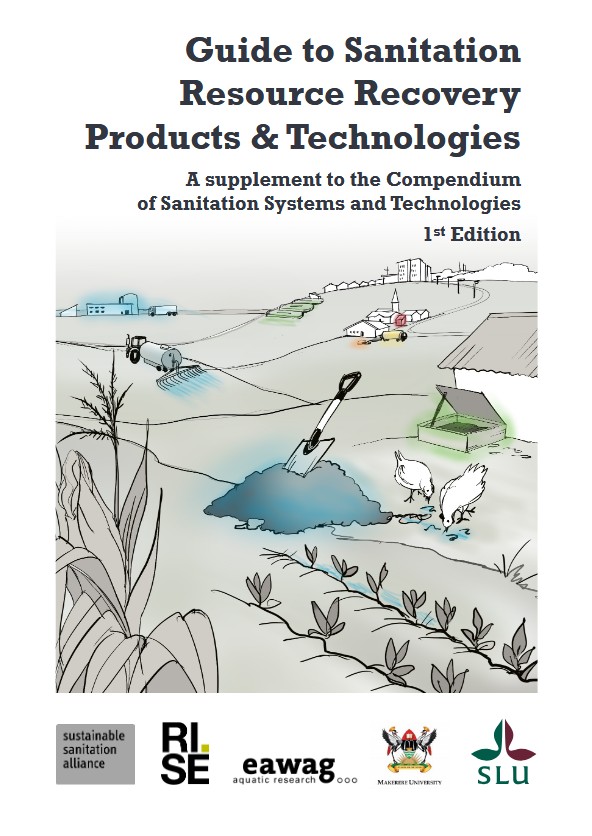
Guide to Sanitation Resource Recovery Products & Technologies A supplement to the Compendium of Sanitation Systems and Technologies 1st Edition
 |
Guía Jan 2021 ; 148 páginas

Ed. EAWAG - Dubendorf SLU - Uppsala
Formato descargable: PdF
Descargable desde el editor
 Compendium of Sanitation Systems and Technologies
Résumé:
Compendium of Sanitation Systems and Technologies
Résumé:L’objectif de ce document est de présenter une vue d’ensemble des possibilités de valorisation des ressources issues de l’assainissement et de fournir des orientations sur les procédés de traitement permettant d’obtenir des produits sûrs pour la réutilisation. Ce document se concentre principalement sur la valorisation des ressources provenant des déchets organiques gérés dans les systèmes d’assainissement et, dans une moindre mesure, sur la récupération de l’eau et la production d’énergie. Les systèmes d’assainissement avec valorisation des ressources sont définis comme des systèmes qui recyclent en toute sécurité les excrétas et les déchets organiques tout en minimisant l’utilisation de ressources non renouvelables telles que l’eau et les produits chimiques. Le recyclage sûr signifie que les flux de déchets sont gérés de manière à réduire au minimum les risques physiques, microbiologiques et chimiques. Ainsi, le produit recyclé ne doit présenter aucun risque significatif pour la santé ni d’impact environnemental lorsqu’il est utilisé correctement. Abstract:
The aim of this document is to provide an overview of the possibilities for resource recovery from sanitation and provide guidance on treatment processes to achieve safe products for reuse. The focus of this document is on resource recovery from the organic wastes managed in sanitation systems and, to a lesser extent, on the recovery of water and energy generation. Resource recovery sanitation systems are defined as systems that safely recycle excreta and organic waste while minimising the use of non-renewable resources such as water and chemicals. Safe recycling means that waste flows are managed so that physical, microbial and chemical risks are minimised. Thus, the recycled product should not pose any significant health threat or environmental impact when correctly used. Contents:
Introduction 7
Terminology 10
Reading the Information Sheets 14
Part 1: Reuse Products 20
R.1 Stored Urine 22
R.2 Concentrated Urine 24
R.3 Sanitised Blackwater 26
R.4 Digestate 28
R.5 Nutrient Solutions 30
R.6 Dry Urine 32
R.7 Struvite 34
R.8 Dried Faeces 36
R.9 Pit Humus 38
R.10 Dewatered Sludge 40
R.11 Compost 42
R.12 Ash from Sludge 44
R.13 Biochar 46
R.14 Nutrient-Enriched Filter Material 48
R.15 Algae 50
R.16 Macrophytes 52
R.17 Black Soldier Fly Larvae 54
R.18 Worms 56
R.19 Irrigation Water 58
R.20 Aquaculture 60
R.21 Biogas 62
Photos of Reuse Products 64
Part 2: Treatment Technologies 66
T.20 Vermicomposting and Vermifiltration 68
T.21 Black Soldier Fly Composting 70
T.22 Algae Cultivation 72
T.23 Microbial Fuel Cell 74
T.24 Nitrification and Distillation of Urine 76
T.25 Struvite Precipitation 78
T.26 Incineration 80
T.27 Carbonisation 82
T.28 Solar Drying 84
T.29 Membranes 86
T.30 Filters 88
T.31 Alkaline Dehydration of Urine 90
T.32 Ammonia Sanitisation/Urea Treatment 92
T.33 Lime Sanitisation 94
Photos of Treatment Technologies 97
Part 3: Cross-Cutting Issues 98
X.1 Pathogens and Safe Reuse of Products 99
X.2 Medication Residues and Other Emerging Contaminants 102
X.3 Fertilising with Reuse Product 104
X.4 Issues of Acceptance 109
X.5 Business Models 112
X.6 Policy Implications 115
Connecting Technologies in the Eawag Compendium 118
Glossary 120
References 128
Palabras claves: |
reutilización de los lodos (CI) (DT) (HP) (ope) , reutilización del agua residual (CI) (DT) (HP) (ope) |
Editores/Difusores: |
|
EAWAG
-
Institut Fédéral Suisse des Sciences et Technologies de l’Eau - Dubendorf - Suiza |
SLU
-
Swedish University of Agricultural Sciences - Uppsala - Suecia |
Si hay un enlace roto, estaremos encantados de recibir un mensaje: communication@pseau.org